Only This Is Truly Digital Production Planning
Digital Production Planning Explained in Brief
Digital production planning describes the data-based evaluation of production systems before decisions are implemented on the line. The aim is to achieve the best possible planning under realistic framework conditions and to evaluate its effects transparently.
In synchronized assembly, complex dependencies arise between work processes, variants, cycle times, restrictions and worker capacity. Digital production planning makes these relationships calculable. This makes it possible to see where stability arises and where risks lie.
A key feature is the scenario capability. Planners systematically compare different assumptions with each other without having to manually rebuild each planning status. This allows specific changes to be evaluated before they take effect in the line.


The planning shows not just one state, but several possible versions of the same system. This makes it clear which levers have which effect.
Digital production planning is therefore not an IT project, but a planning approach. It combines specialist knowledge from assembly, industrial engineering and logistics with mathematical evaluation. Decisions are no longer based on experience alone, but on comprehensible key figures.
Why Traditional Planning Approaches Are Reaching Their Limits
Traditional production planning is often based on tables, empirical values and individual considerations. As long as quantities are stable and the range of variants remains limited, this approach is often still manageable in terms of effort. At the same time, planning usually takes place within known solution spaces. New solutions or alternative scenarios are difficult to find systematically using traditional approaches. In variant-rich, synchronized assembly, however, complex dependencies quickly arise that can no longer be reliably mapped using static methods.
A central problem is the static view of a dynamic system. Tables show a planning status, but no cause-and-effect relationships. If the variant mix changes or new work processes are added, numerous assumptions have to be adjusted manually. The effects on capacity utilization, bottlenecks or time spread often remain hidden or are only recognized very late.
Added to this is the high frequency of change in real production systems. Product launches, model maintenance, fluctuations in the number of units or cycle time changes require continuous adjustments to the line balancing. In classic approaches, this means copying, shifting and recalculating across many table statuses. The planning effort increases, while the reliability of the results decreases.
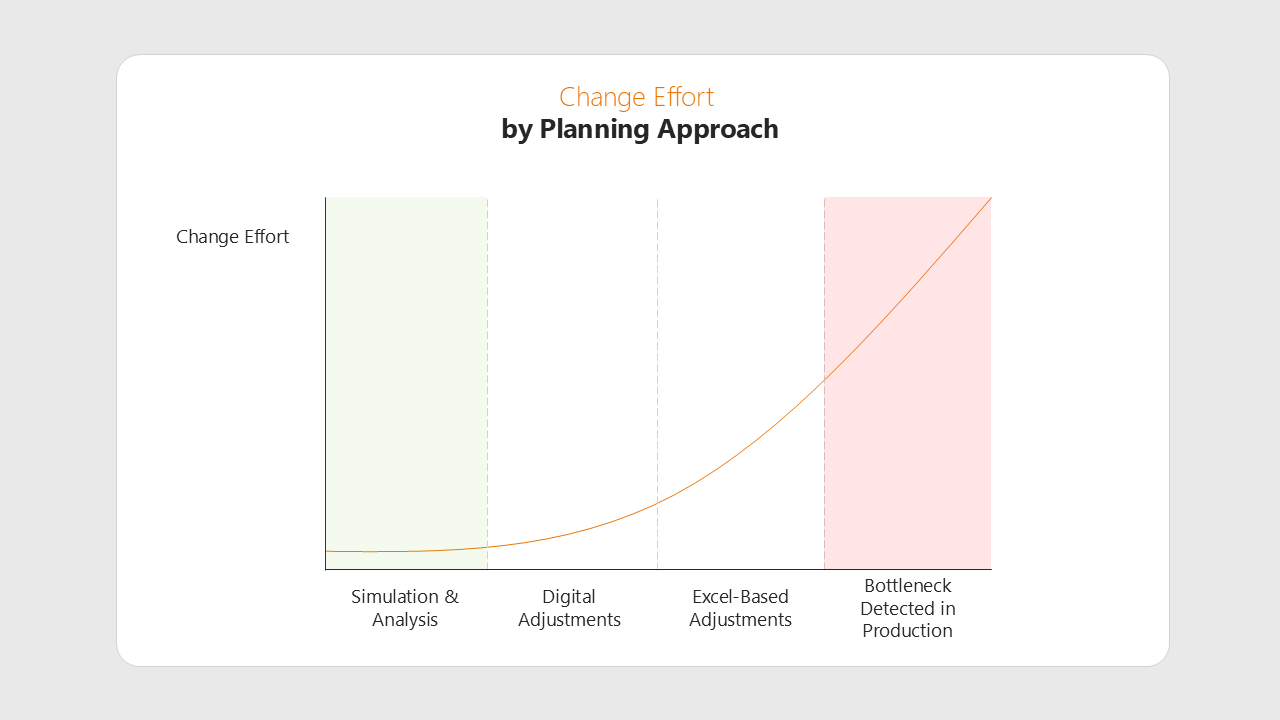
Dealing with risks is particularly critical. If bottlenecks or overloads are not simulated in advance, they only become apparent during operation. The necessary reactions, additional workers, redistribution or short-term interventions, are associated with significantly higher costs. These costs do not increase linearly, but exponentially, the later a risk is identified. Planning then no longer reacts preventively, but in a compensatory manner.
Another weak point is the limited comparability of planning statuses. Different table versions, individual logics and local adjustments make it difficult to properly evaluate alternatives. Decisions are delayed or based on incomplete transparency. The limits of classic production planning are therefore not methodological, but systemic.
What Is “Digital” About Digital Production Planning?
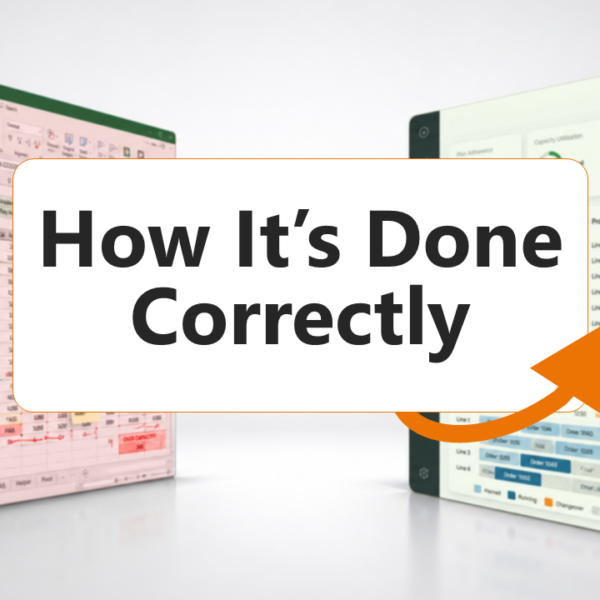
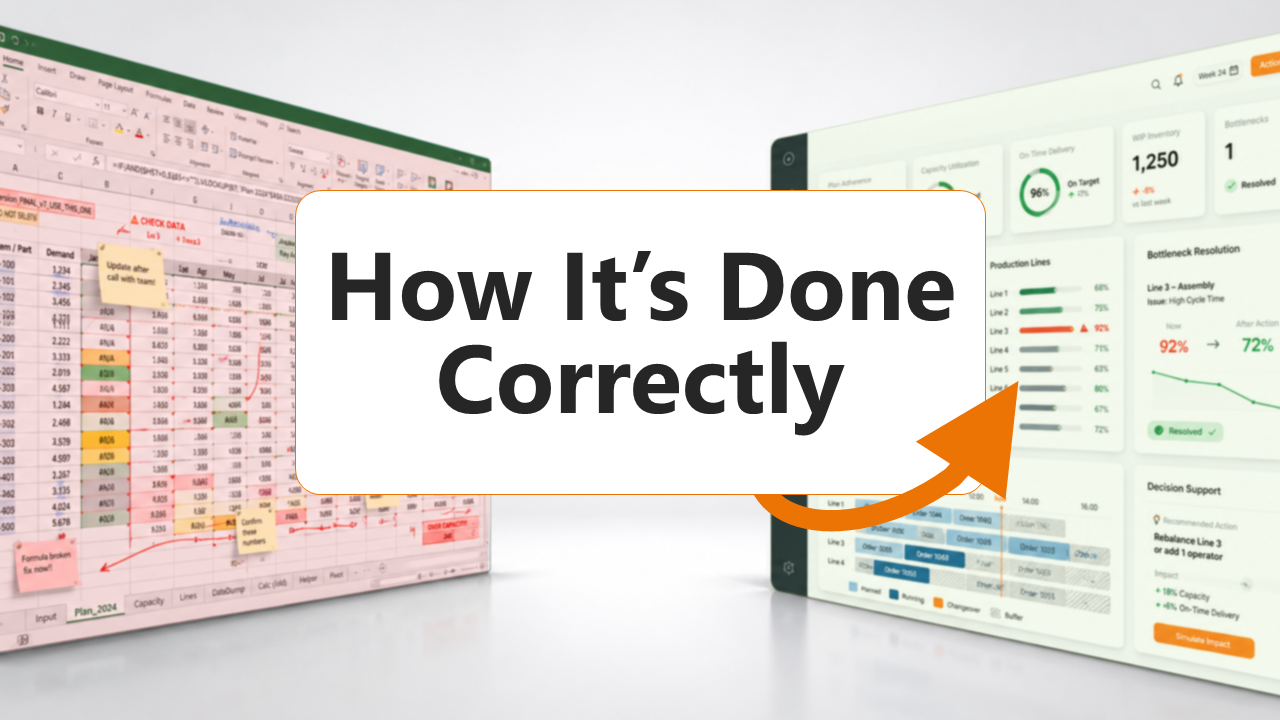
In production planning, “digital” does not mean replacing existing Excel spreadsheets. The key is to switch from static plans to a consistent data model. Work processes, workstations, times and restrictions are clearly described and are clearly interrelated.
The second difference lies in the scenario logic. Digital production planning does not work with a single truth, but with comparable planning statuses. If cycle times, take rates or the variant mix change, alternative scenarios are created. These can be evaluated objectively without overwriting existing planning.
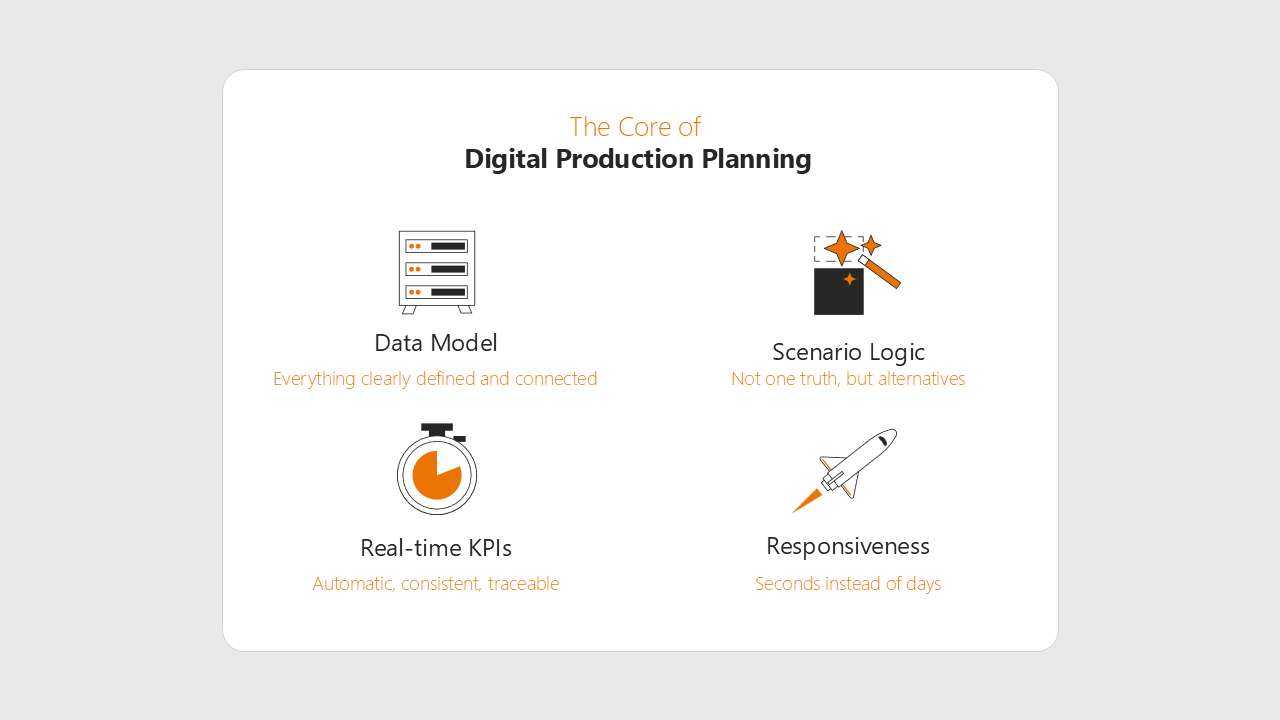
Another feature is the consistent calculation of key figures. Utilization, bottlenecks or time spread are not calculated manually, but are derived automatically from the underlying data. If a parameter changes, the key figures change immediately. Cause and effect remain traceable.
Production planning also becomes digital through its reaction speed. Changes can be evaluated in seconds instead of taking days to calculate. This shifts the focus from plan creation to decision-making. Planning becomes an active control instrument rather than a reactive document.
Which Decision Questions Can Be Evaluated Mathematically
Digital production planning does not answer abstract questions about the future, but concrete planning questions from everyday assembly. The focus is on the systematic evaluation of if-then relationships in order to derive the best possible planning for a given situation. It is precisely this transparency about interdependencies that is crucial for reliable decisions.
A central issue concerns the stability of the line balancing. Planners can see whether a line will remain in cycle with a changed mix of variants or whether overloads will occur. Not only the average utilization is considered, but also the range of the load per order. Only this time spread shows whether individual variants systematically cause problems.
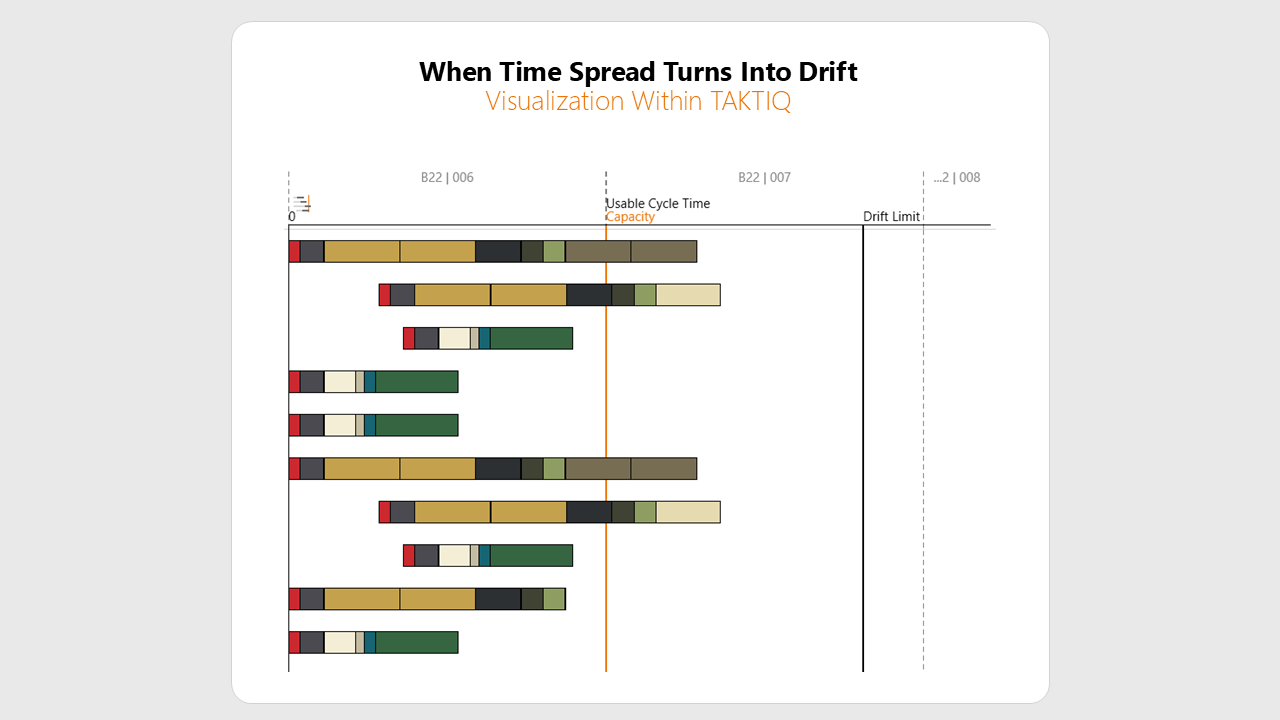
Bottleneck questions can also be answered in a targeted manner. Digital production planning makes it clear at which workstations risks arise and why. A bottleneck is not necessarily the workstation with the highest average capacity utilization. Bottlenecks are often caused by unfavorable combinations of variants, restrictions or unfavorable drift behavior. These causes can be calculated.
Another focus is on change decisions. If the cycle time is to be adjusted or the number of workers varies, the planning shows what impact this will have on capacity utilization, time spread and necessary support costs. This allows different options to be compared before organizational or personnel measures are implemented.
Last but not least, digital production planning answers the question of robustness. Planners recognize which solutions remain stable even with moderate deviations and which only work under ideal conditions. This assessment is crucial for series production, where deviations are the rule rather than the exception.
Why Digital Production Planning Increases the Quality of Decision-Making
The quality of a production decision is not reflected in the plan, but in its implementation. Digital production planning improves this quality by reducing uncertainties before measures take effect in the line. Decisions are no longer based on assumptions, but on transparent interdependencies.
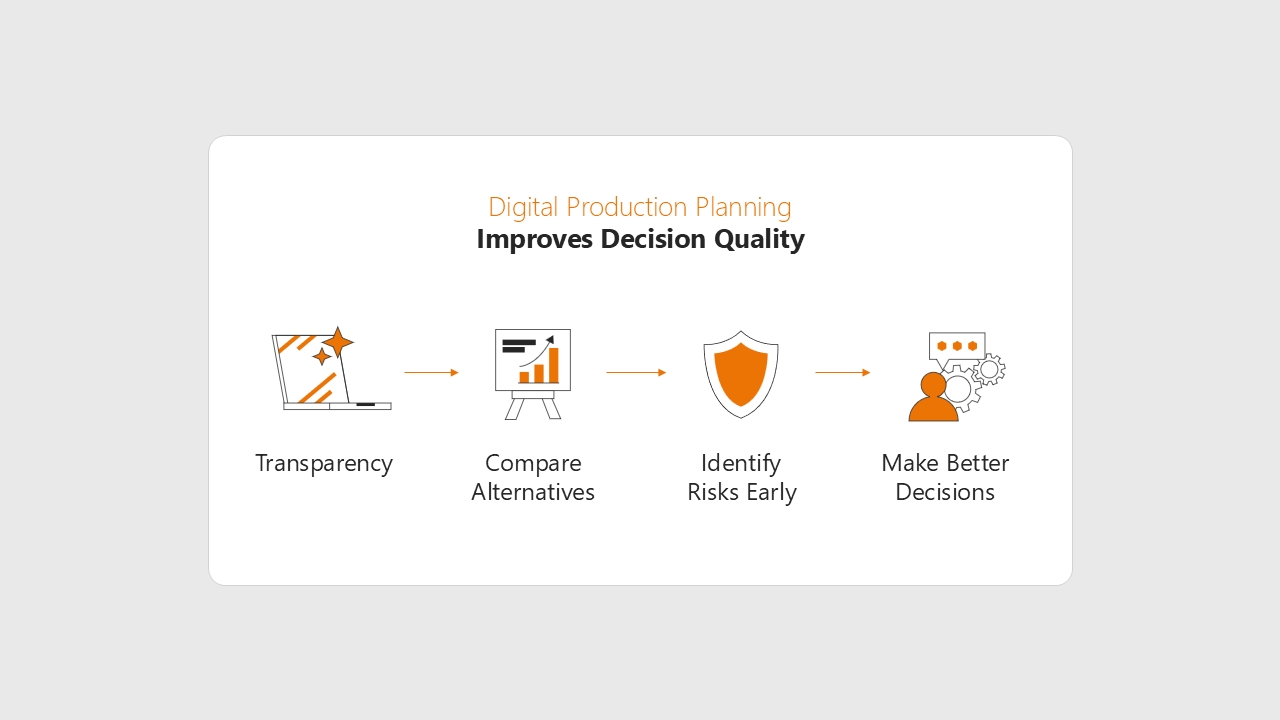
A key effect is the separation of gut feeling and facts. Experience remains important, but is supplemented by reliable key figures and documented transparently. If planners can see how a variant mix, cycle time or restrictions affect capacity utilization and time spread in concrete terms, decisions can be objectively justified. This increases acceptance across departments.
Added to this is the comparability of alternatives. Digital production planning makes it possible to evaluate several scenarios under identical framework conditions. Differences are not caused by different calculation logics, but by real parameter changes. This makes it clear which solution is more robust and which only works under ideal conditions.
Another advantage lies in the temporal decoupling of decision and effect. Risks are identified while there is still room for maneuver. Measures can be planned, prioritized and coordinated before operational interventions are necessary. This reduces short-term compensation and increases stability in series production.
In the long term, this will also change the role of planning. It is changing from a reactive problem solver to an active decision supporter. Digital production planning creates the basis not to simplify complexity, but to make it manageable. This is precisely its key benefit.
Frequently Asked Questions About Production Planning
Traditional production planning describes a state, digital production planning evaluates interdependencies. While tables depict a plan, digital models show how changes affect capacity utilization, time spread and stability. Decisions can therefore be checked before they are implemented. This reduces the need for subsequent corrections during operation.
No, it is not the size of the plant that is decisive, but the complexity of the assembly. A wide range of variants, synchronized lines and frequent disruptions significantly increase the benefits of digital planning. Smaller lines also benefit if the focus is on stability and decision-making quality.
Simulation is not an end in itself, but a tool for evaluating decisions. It shows how real order programs behave under changed conditions. This makes risks visible before they occur in the line. Planning becomes preventative instead of reactive.
No, digital production planning does not replace experience, but complements it. Technical knowledge is made effective in a model and evaluated mathematically. Planners retain the authority to make decisions, but do so on the basis of transparent and comprehensible effects.
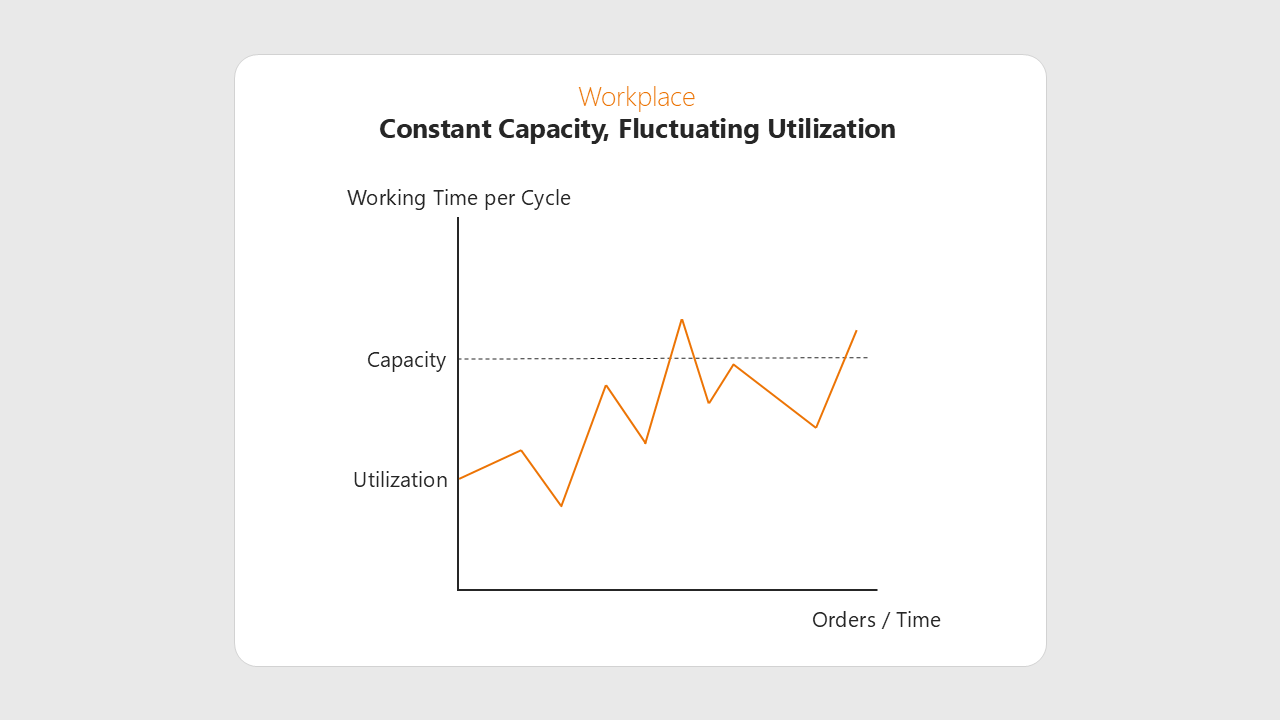
Capacity is constant, utilization is dynamic. Why variant mix, line balancing and time spread determine production stability.
Learn More

Many assembly lines are formally considered to be "in cycle" and yet fail to meet their stability targets. The planned number of units is only achieved with additional effort. Jumpers are regularly deployed, rework occurs outside the line and minor disruptions escalate quickly.
Learn More