From MTM Time Data in TiCon to Stable Line Balancing in TAKTIQ
Webinar: TiCon and TAKTIQ Working Together
How can “Methods-Time Measurement” (MTM) time data from TiCon be used directly for line balancing in TAKTIQ? That’s exactly what we’ll demonstrate in our joint webinar with MTM SOLUTIONS GmbH. You’ll see how MTM time data is created in TiCon, sent to TAKTIQ, and used there for interactive or automatic line balancing.
A practical example illustrates the entire process: from analyzing individual tasks in TiCon to evaluating the line in TAKTIQ. After importing the time data, TAKTIQ calculates the utilization of workplaces, identifies bottlenecks, and allows for scenarios with modified order schedules, product mixes, or cycle times.
What Advantages MTM Time Data Offer for Line Balancing
Realistic line balancing requires reliable processing times. It is crucial to know which tasks are required for which variants and how much of a workload this places on individual workplaces.
The webinar demonstrates how TAKTIQ performs calculations in the background using the complete order portfolio and takes rate values into account for each variant. If lead times are inaccurate or out of date, this results in incorrect capacity utilization figures. The actual bottlenecks then remain hidden or are identified too late.


Structured MTM time data from TiCon provides a transparent basis for planning. The times are not only documented but can also be used directly for line balancing, scenario comparison, and optimization.
Unlock the webinar recording now
From MTM Time Analysis to Optimized Line Balancing
In TiCon, work tasks are analyzed and time-evaluated using the MTM method. The webinar demonstrates how an assembly operation is broken down into individual process steps and documented as a time analysis. This includes, for example, walking to the material supply area, positioning, snapping into place, handling a tool, and securing a wiring harness.
This data can then be sent to TAKTIQ via the TiCon REST API. In TAKTIQ, we then receive the tasks along with their assigned times.
TAKTIQ evaluates the data in the context of the order portfolio and mix of variants. This reveals which variants place a greater load on a workplace. Changes to take rates, cycle times, or the order portfolio can then be easily simulated and tested in a scenario.
The webinar also demonstrates how TAKTIQ supports manual, interactive, and automatic line balancing. Tasks can be rescheduled, constraints can be taken into account, and overloads can be reduced. This transforms the initial time analysis into a concrete basis for decision-making in assembly planning.
Frequently Asked Questions About Time Data
MTM stands for Methods-Time Measurement. It is a time management method used to break down manual workflows into individual movement and process steps and assign standardized time values to them. This results in traceable processing times for tasks. In the context of the webinar, this MTM time data serves as the basis for reusing tasks from TiCon in TAKTIQ for line balancing.
This illustrates the workflow from TiCon to TAKTIQ. MTM time data is created in TiCon, transferred to TAKTIQ, and used there for line balancing, simulation, and optimization.
The webinar is aimed at employees in time management, industrial engineering, assembly planning and production management.
TAKTIQ uses these times as processing times for tasks. Based on this data, the software calculates capacity utilization, standard time, bottlenecks, and scenarios for line balancing.
Time data is not only documented but also used directly for planning. This makes it possible to assess capacity utilization, bottlenecks, and scenarios more quickly.


The cycle time sets the pace of an assembly line, but it is not the sole factor determining the line’s stability. Especially on lines with a wide variety of products, a station may operate below its average capacity and still be regularly overloaded. The difference between a line that is only theoretically at full capacity and one that is truly stable lies in line balancing.
Learn More
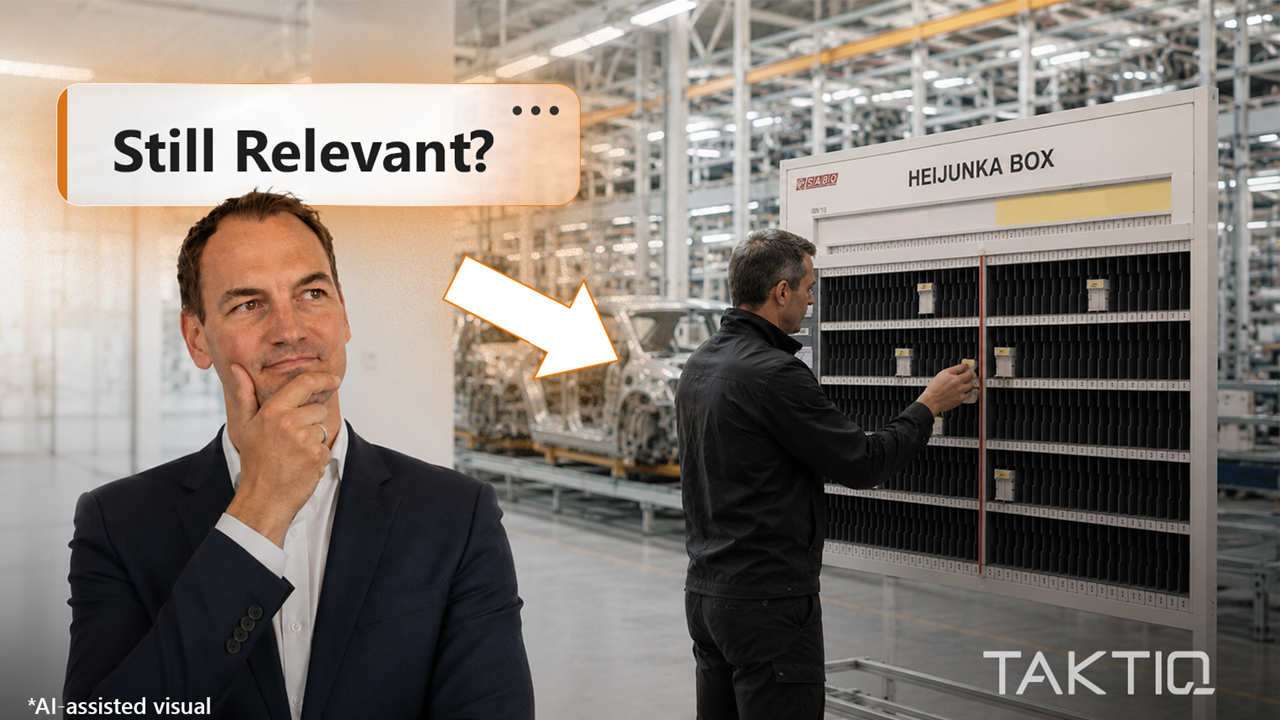
Why traditional lean tools reach their limits when there is a high degree of product variety, and why line balancing becomes the foundation for effective lean initiatives.
Learn More

How sequencing rules are derived analytically, and why this prevents significantly more bottlenecks than the traditional approach.
Learn More