Lean Tools in High-Variety Assembly Lines
Lean tools have been established in the automotive industry for decades and have since become widespread throughout the entire vehicle manufacturing sector: trucks, buses, agricultural machinery, excavators, cranes, forklifts, vans, and RVs. The principles are widely known, and the methods are widely used. And yet, practical experience shows that Lean cannot simply be reduced to the shop floor textbook in high-variety assembly. The greater the variety of variants, the more traditional Lean tools reach their structural limits, and the more important the foundation on which they rest becomes.
Which Lean Methods Are Relevant in High-Variety Assembly
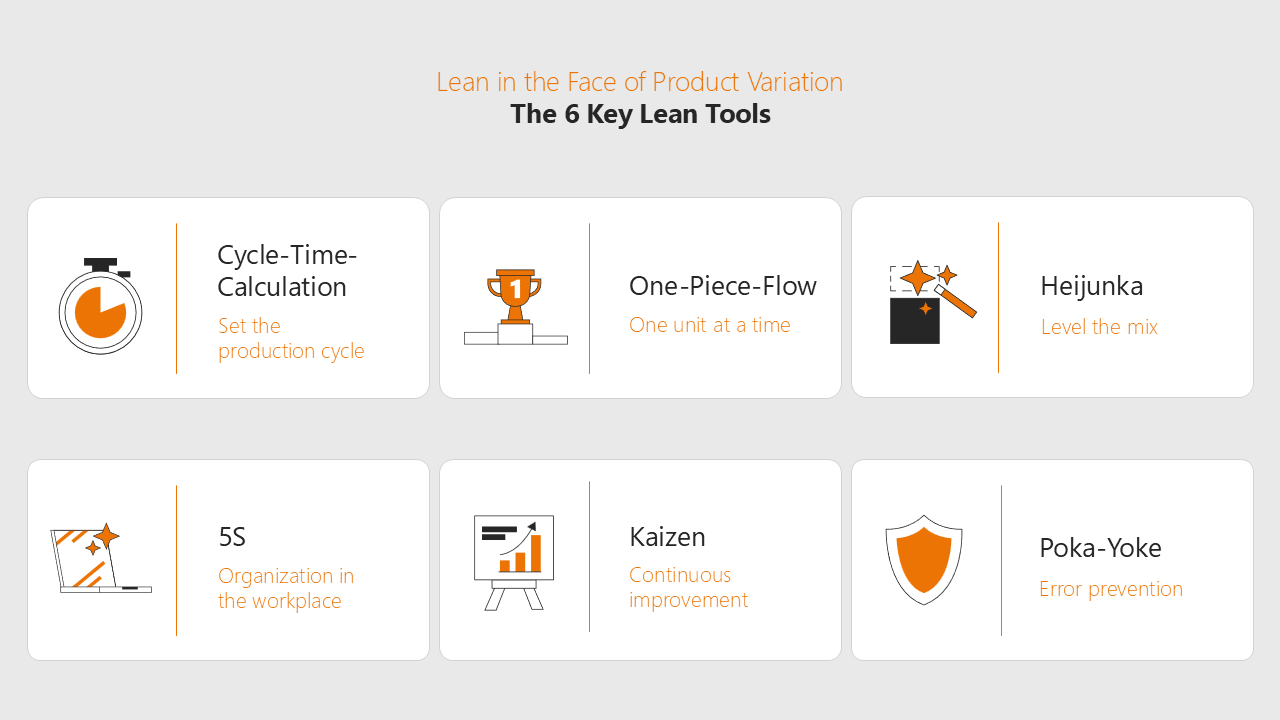
Not all well-known lean tools are equally relevant in the context of modern, high-variety assembly lines. Six of them are central to industrial engineering practice.
The
By contrast, two methods frequently associated with Lean play virtually no role in the context of high-variety assembly. Value Stream Mapping (VSM) focuses on material flow chains with few, stable variants. In high-variety assembly, the complexity lies not in the material flow chain, but in the variety of variants itself. SMED
Where Traditional Lean Tools Reach Their Limits When Dealing with a Wide Range of Variants
The methods mentioned generally work. However, their effectiveness diminishes as the number of variants increases. With several hundred different variants per shift, five typical bottlenecks arise that can no longer be resolved using Lean methods alone.
The
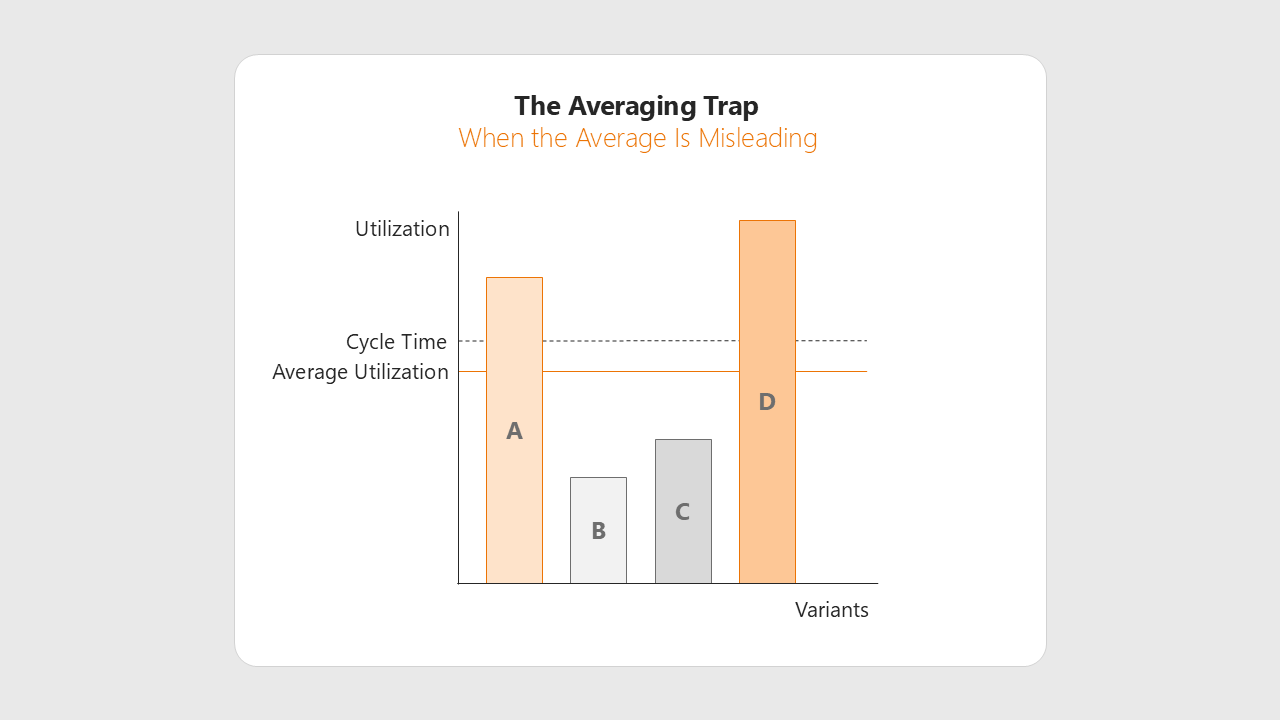
„At automotive manufacturers, production volumes and cycle times are often planned strictly according to customer demand or sales targets. A shorter cycle time may not seem critical at first if the average utilization per workplace is appropriate. The danger, however, lies in individual variants with high utilization rates. After a reduction in cycle time, these can overload stations and, in the worst case, trigger production line stoppages, even though the average figures appeared normal. “


Heijunka reaches a
5S faces a standardization dilemma: A high degree of product variety directly undermines the standardization of work processes, because each variant requires a different sequence of steps. Standard work sheets, which are a classic tool of the fourth S, can no longer be treated as static checklists. Kaizen workshops suffer from an obsolescence problem: The optimizations are heavily tailored to the variants being produced on the day of the workshop. If the product mix changes shortly thereafter, they can quickly become outdated or even counterproductive. The effort involved in a multi-day workshop is then no longer proportional to the lasting benefit. Finally, poka-yoke is undermined by cognitive overload: working in a cycle leaves no time to look up instructions. Labor-intensive variants also cause additional delays and stress, which further increases the likelihood of errors.
„At a commercial vehicle manufacturer, extensive Kaizen workshops were conducted, featuring detailed analyses of individual workplaces. The optimizations identified were heavily tailored to the variants being produced on the day of the workshop. Other variants, which also occur regularly, were not taken into account. The lesson here: All Lean initiatives must take the entire range of variants into account. In the shop floor setting of a workshop, this is virtually impossible to achieve, which underscores the need for digital tools. “
Line balancing as a Foundation and as Continuous Improvement in Practice
Line balancing, that is the distribution of operations and operators across the workstations of a line, is not an additional Lean tool. It is the foundation upon which the other methods can be effective in high-variety assembly. Only when the tasks are evenly distributed can Kaizen and 5S effectively optimize processes, Poka-Yoke ensure quality, and Heijunka further smooth out order flow. Lean methods optimize within the structure defined by line balancing. If the structure is not right, the achievable optimum is capped.
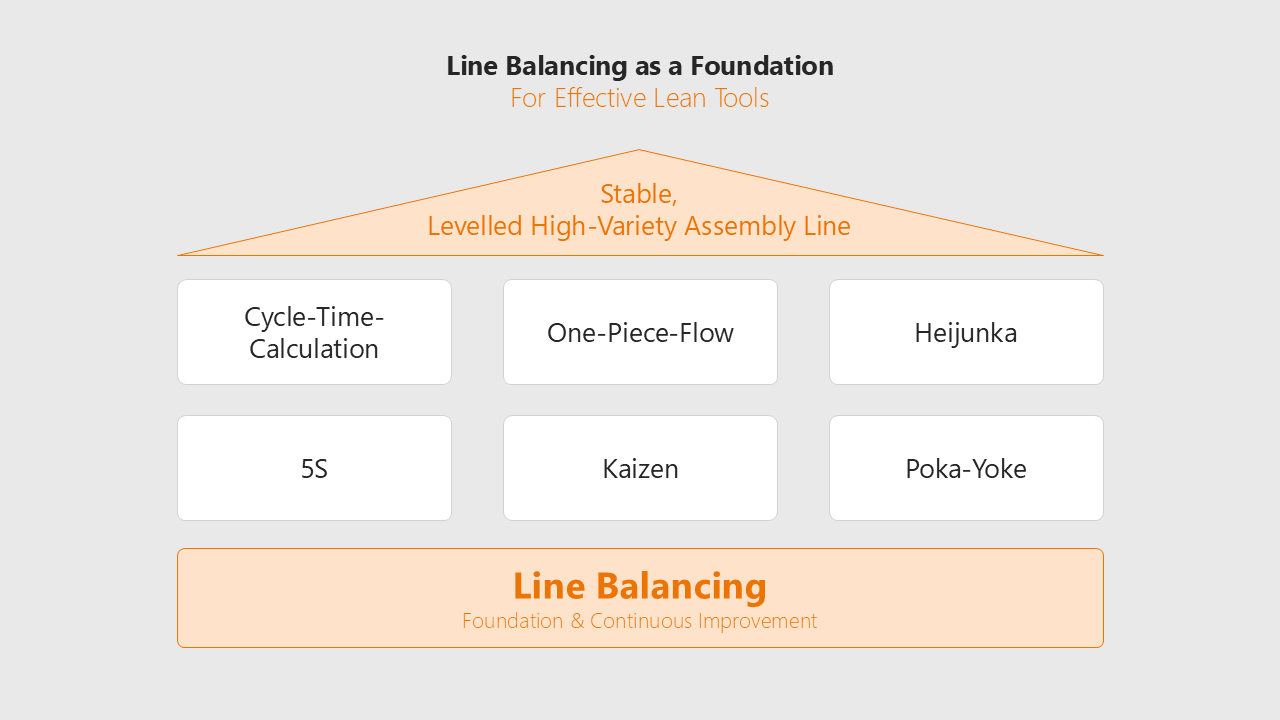
Once line balancing has been done, it is not a permanent state. It becomes outdated as soon as the variant mix moves, new optional equipment is planned, or production volumes change. Regular line balancing is therefore not only a mandatory task of industrial engineering but also a structural form of continuous improvement, complementing workplace-level Kaizen activities. Effective line balancing directly addresses the three central sources of waste in Lean thinking: It prevents overloading of individual workplaces (Muri), balances out fluctuations in workload across workplaces (Mura), and reduces waiting and idle times resulting from unbalanced workplaces (Muda). Line balancing thus not only fits into the Lean concept as a prerequisite but is itself a practical application of the Lean philosophy.
„In the automotive industry, line balancing is typically adjusted monthly to reflect the updated order program. In other industries, this often occurs only when necessary or during major physical reconfigurations, which causes the line balancing to deviate from the optimal state for months at a time. Significant improvements were observed among customers in the motorhome manufacturing sector after they performed a new line balancing adjustment based on the current order program for the first time. However, what matters most is not the one-time action, but the ability to repeat it regularly and with manageable effort. This requires appropriate processes and digital tools. “
How Digital Scenarios Validate Lean Initiatives Before Implementation
In high-variety assembly, Lean measures can no longer be implemented on an ad hoc basis. Before any change takes effect on the production line, whether a new cycle time, a modified variant mix, or the addition or elimination of a worker position, it must be analyzed against the full range of product variants and realistic order programs. This is exactly what digital scenario tools do.
There are three standard scenarios, and each is clearly linked to lean principles.
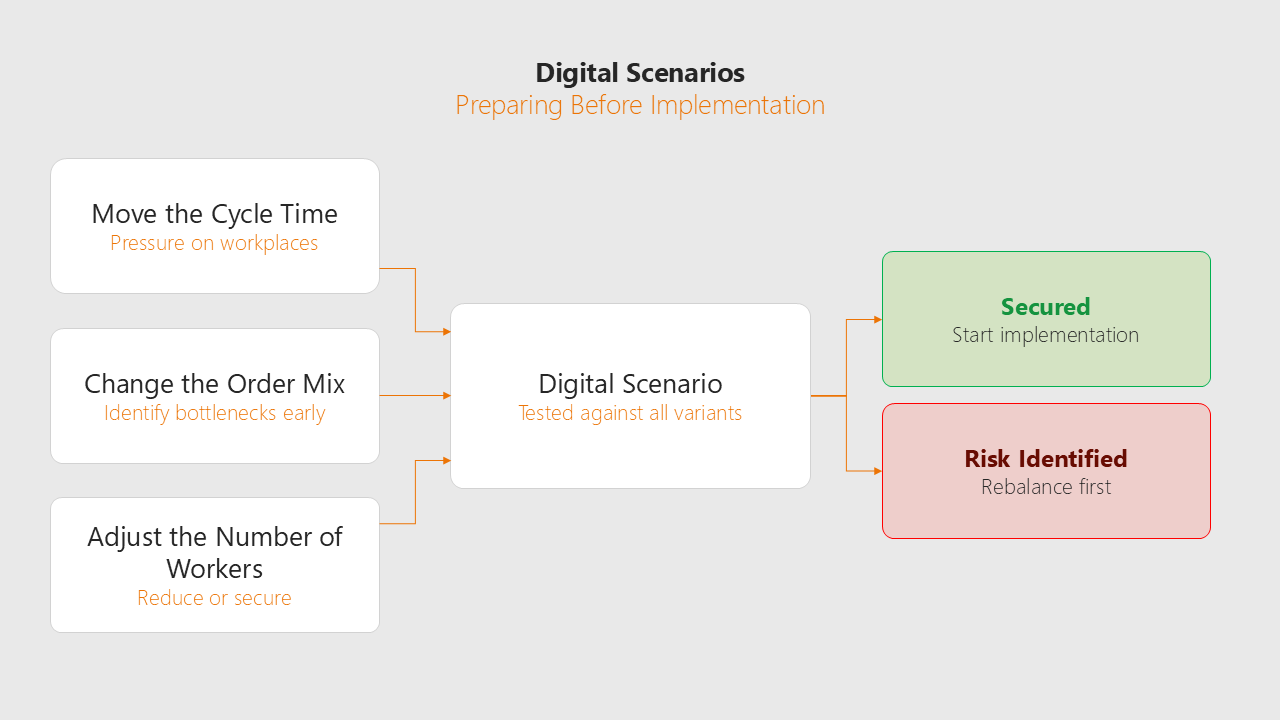
The first is to move the cycle time, specifically its reduction. A shorter cycle time means less time per order and, consequently, greater pressure on each workplace. Before implementation, it is essential to calculate how the new cycle will affect all variants, especially those with high utilization rates. This allows the customer-driven cycle time principle to be applied effectively without falling into the “average trap” discussed in Chapter 2.
The second scenario involves a change in the order mix. The variant mix often moves at short notice due to customer orders or sales targets. Digital scenarios make it possible to compare an expected future mix with the current line balancing and identify bottlenecks before the new product line enters production. This serves both to adapt to customer demand and as the digital precursor to Heijunka leveling.
The third scenario concerns the number of workers. Avoiding waste (muda) is a core principle of the Lean philosophy and includes workforce allocation. Before a production line operates with fewer workers, it must be ensured that this is viable for all product variants and expected order programs. Conversely, workers can be strategically added to make critical workplaces more robust and prevent errors or downtime. This is the personnel-based version of the poka-yoke principle.
„At an automotive customer, the shift schedule was reorganized, thereby reducing the cycle time. At the same time, a change in the order mix was anticipated. First, the workplaces with the highest risk of overload were identified, and additional workers were specifically scheduled for those workplaces. Through rebalancing, the tasks were redistributed in such a way that a leveled production line with the target capacity utilization was achieved. In retrospect, the planners noted that this change would not have been feasible within the available time without digital tools. “
What It Takes for Lean Tools to Be Effective in High-Variety Assembly
There is a widespread belief that Lean is closely tied to the shop floor and therefore does not require a detailed data foundation. This is misleading in high-variety assembly. On the shop floor, you only ever see a snapshot of individual variants. The impact of Lean across the entire range of variants cannot be assessed from there. That is precisely why Lean, especially in high-variety assembly, needs a solid data foundation.
The mandatory data set includes complete tasks with process times determined using sound methodology. The times must come from accurate time tracking; estimates or outdated values lead to line balancing. Variant-specific differences in processing time must be accurately reflected. Equally important is order data with detailed variant information: Which variants are produced in what quantities on the line, with what special equipment, and with what combinations of characteristics? Ideally, this data is directly linked to the ERP system so that planning is always based on the current order program.
However, data alone is not enough. Clear data owners and defined verification processes are needed, typically in industrial engineering and work planning, as well as standardized processes for regular review and correction. Without this discipline, digital planning gradually loses its foundation. A regular rebalancing cycle is equally important. Those who wait to initiate rebalancing until utilization visibly tips over have missed the window for preventive adjustments. A fixed schedule, such as monthly, based on the actual pace of change in the order program makes sense.
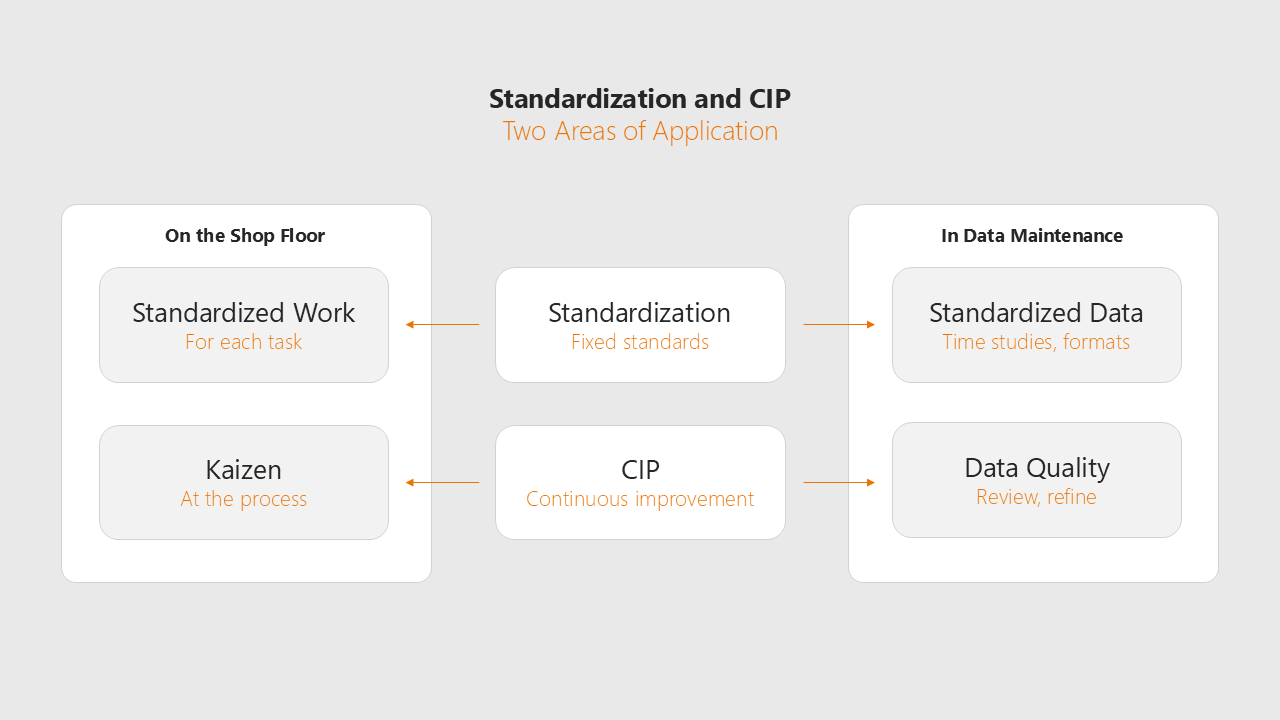
Lean logic also applies to data maintenance itself. Standardization means clear standards for time studies, data formats, and maintenance intervals. Continuous improvement means regularly reviewing and refining data quality, following the same CIP principles that are applied on the workplace. Lean, therefore, does not exist alongside digital planning but permeates it. A clean, actively maintained database is a part of Lean practice itself.
Frequently Asked Questions About Production Planning
In high-variety assembly, cycle time calculation, one-piece flow, Heijunka, 5S, Kaizen, and Poka-Yoke are particularly relevant. These methods help stabilize processes, reduce waste, and prevent errors. However, their effectiveness depends heavily on whether the tasks are appropriately distributed along the line.
Traditional lean tools often focus on individual workplaces, standards, or snapshots of the shop floor. When there is a high degree of product variety, this is not sufficient because each variant can result in different working times and workloads. This can lead to bottlenecks that are not visible when looking at averages.
Line balancing determines which tasks are performed at which workplaces. If this structure is not appropriate, Kaizen, 5S, Heijunka, or Poka-Yoke can only have a limited effect. Only well-balanced line balancing creates the foundation for Lean measures to deliver consistently stable results over the long term.
The “average trap” occurs when a cycle time is evaluated based solely on average utilization rates. Individual variants with high utilization rates can still overload a workplace. After a cycle time reduction, this can lead to bottlenecks or line stoppages, even though the planning appeared unproblematic based on the average.
Line balancing should be reviewed regularly whenever the variant mix, unit quantities, optional equipment, or process times change. On dynamic assembly lines, it makes sense to establish a fixed line balancing schedule, such as monthly.
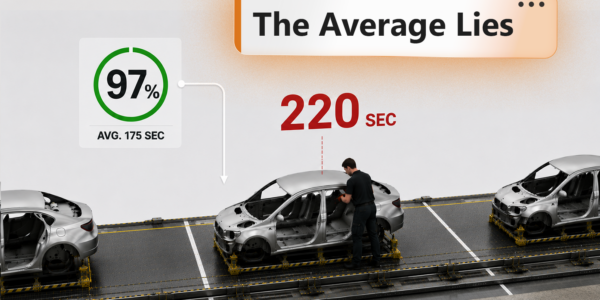
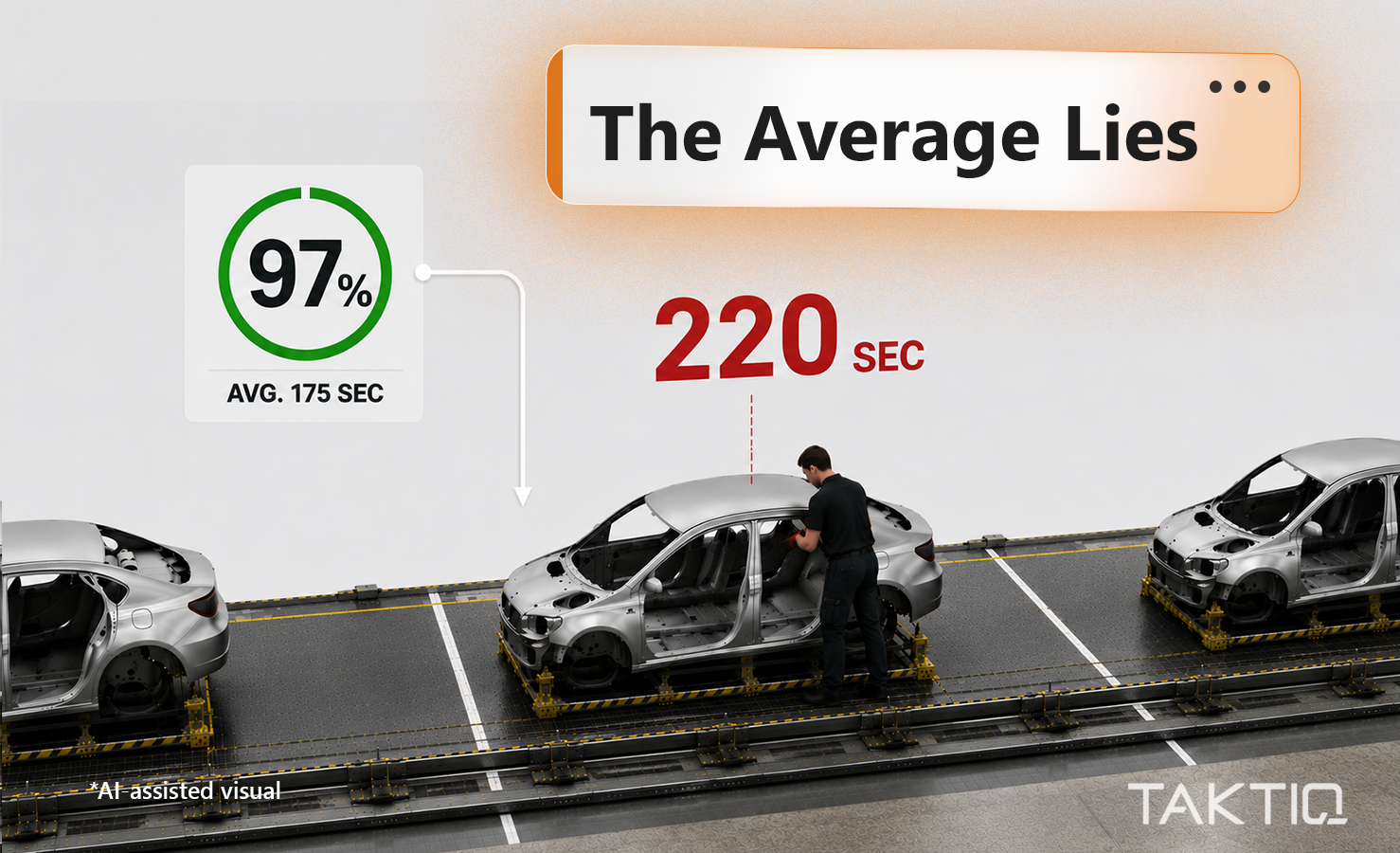
The cycle time sets the pace of an assembly line, but it is not the sole factor determining the line’s stability. Especially on lines with a wide variety of products, a station may operate below its average capacity and still be regularly overloaded. The difference between a line that is only theoretically at full capacity and one that is truly stable lies in line balancing.
Learn More

How sequencing rules are derived analytically, and why this prevents significantly more bottlenecks than the traditional approach.
Learn More
The joint webinar hosted by MTM SOLUTIONS GmbH and TAKTIQ demonstrates how MTM time data leads to stable line balancing.
Learn More