
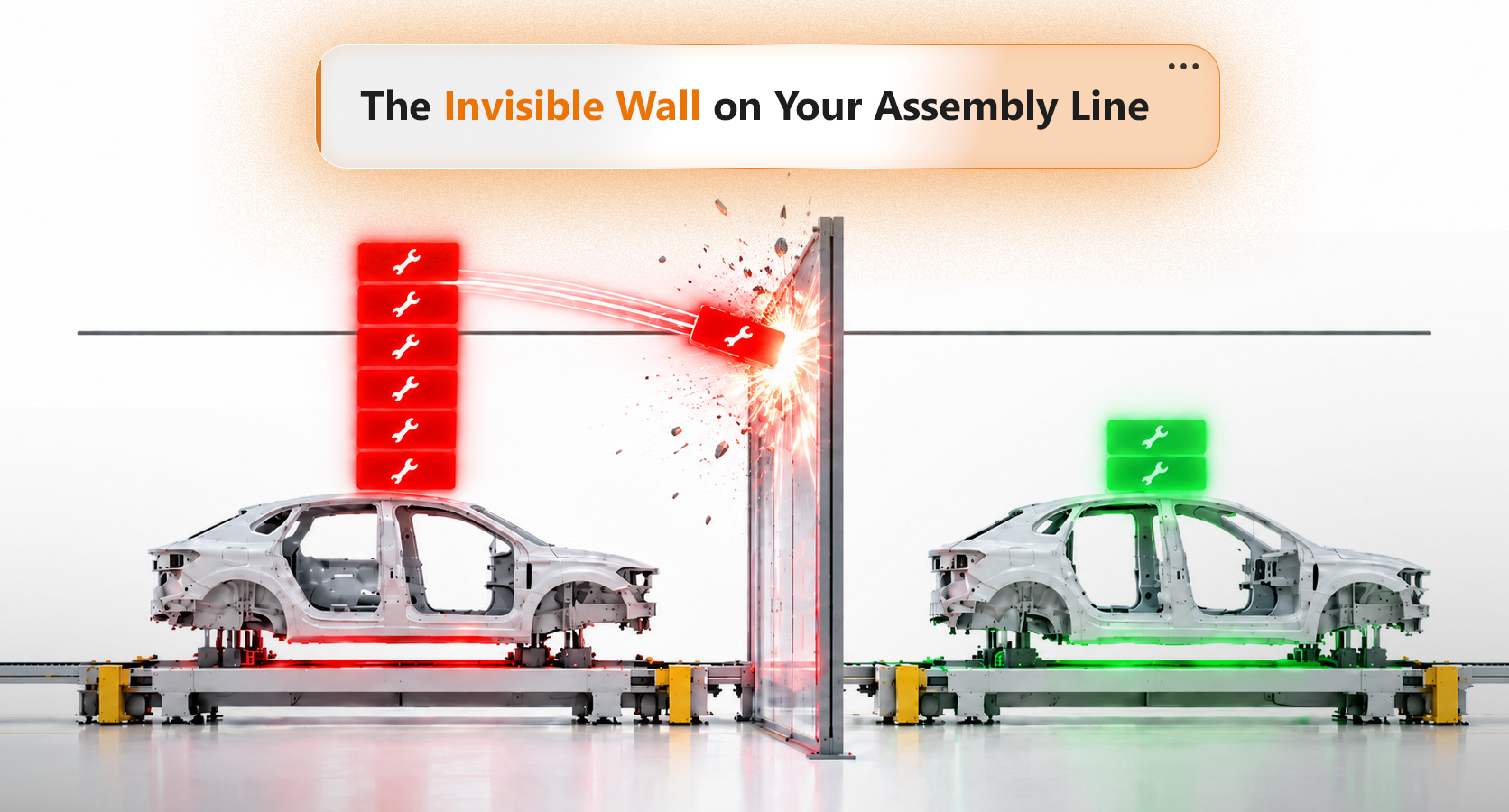
Line Balancing Constraints: No Space Despite Available Capacity
One workplace is overloaded, while another still has unused capacity (idle time), and yet a task cannot be moved there. This is often not due to capacity, but to line balancing constraints. In line balancing (the assignment of tasks to workplaces), a task may only be assigned to a workplace where it complies with all constraints defined for it. Anyone who knows the constraint that is preventing it from moving also knows where to start finding a solution.
Five Types of Constraints: What Limits a Move
Line balancing constraints define the conditions that must be met when assigning tasks to workplaces. There are five types:
- Precedence relation: This specifies that one task must be completed before another, for example, because the window is to be installed only after the preliminary work on the door has been completed. Therefore, the installation of the window must not occur at any station before the preliminary work on the door.
- Distance constraint: It specifies a minimum or maximum number of stations between tasks. When applying adhesive, a component must be installed no later than two stations after the adhesive is applied (maximum distance); however, the bond can only be inspected after the curing time has elapsed (minimum distance).
- Group: This groups together tasks that must be located at the same workplace, for example, because they all require the same handling device. Therefore, they can only be moved together.
- Exclusion Constraint: This prevents two tasks from being assigned to the same workplace. This is necessary when the assembly and inspection of a component are to be performed by different workers.
- Requirement: It allows a task only at work centers where the appropriate equipment is defined as a workplace property. If a task requires a stationary EC screwdriver, only workplaces equipped with this screwdriver are eligible.
Work tasks that are integral to a workplace, such as the walk back to the start of the station, constitute a special case. Such workplace tasks cannot be moved.
Constraint Found: Correct or Find an Alternative
If a task cannot be moved, the first step is to determine which restriction applies. Some constraints are mandatory for technical or quality reasons. Others apply only because of an error in the documentation, for example when a requirement and a workplace property describe the same situation differently. Such errors can be corrected.
If, on the other hand, the constraint is mandatory, the question arises as to which workplace the task can be moved to instead. In TAKTIQ, the preview mode provides the answer. For selected tasks, it shows which workplaces they can be moved to while complying with the active constraints, and how the key metrics would change at the source and destination workplaces. The Suggestion List answers the reverse question: which tasks can be moved to a specific workplace. This makes it clear, especially during a bottleneck, which moves are even feasible.
Constraints are therefore not an obstacle to line balancing, but rather documented knowledge about the assembly process. The more complete and up-to-date this information is, the more reliably one can determine which moves are permissible. Available capacity alone does not make a move possible.
Frequently Asked Questions About Production Planning
There are five types: precedence relations, groups, distance constraints, exclusion constraints, and requirements. Precedence relations specify which task must be performed before another. Groups and exclusion constraints determine whether tasks must or must not be located at the same workplace. Distance constraints specify a minimum or maximum number of stations between tasks, while requirements link a task to the properties of a workplace.
In that case, line balancing conflicts with a condition that must be met in the assembly process and is not permitted in this regard. An example is a task scheduled at a station before its predecessor, such as installing a window before the preparatory work on the door. A constraints validation continuously checks line balancing against all stored constraints and flags any constraint violations. These are resolved by moving the task to a permissible workplace or by correcting an incorrectly stored restriction.
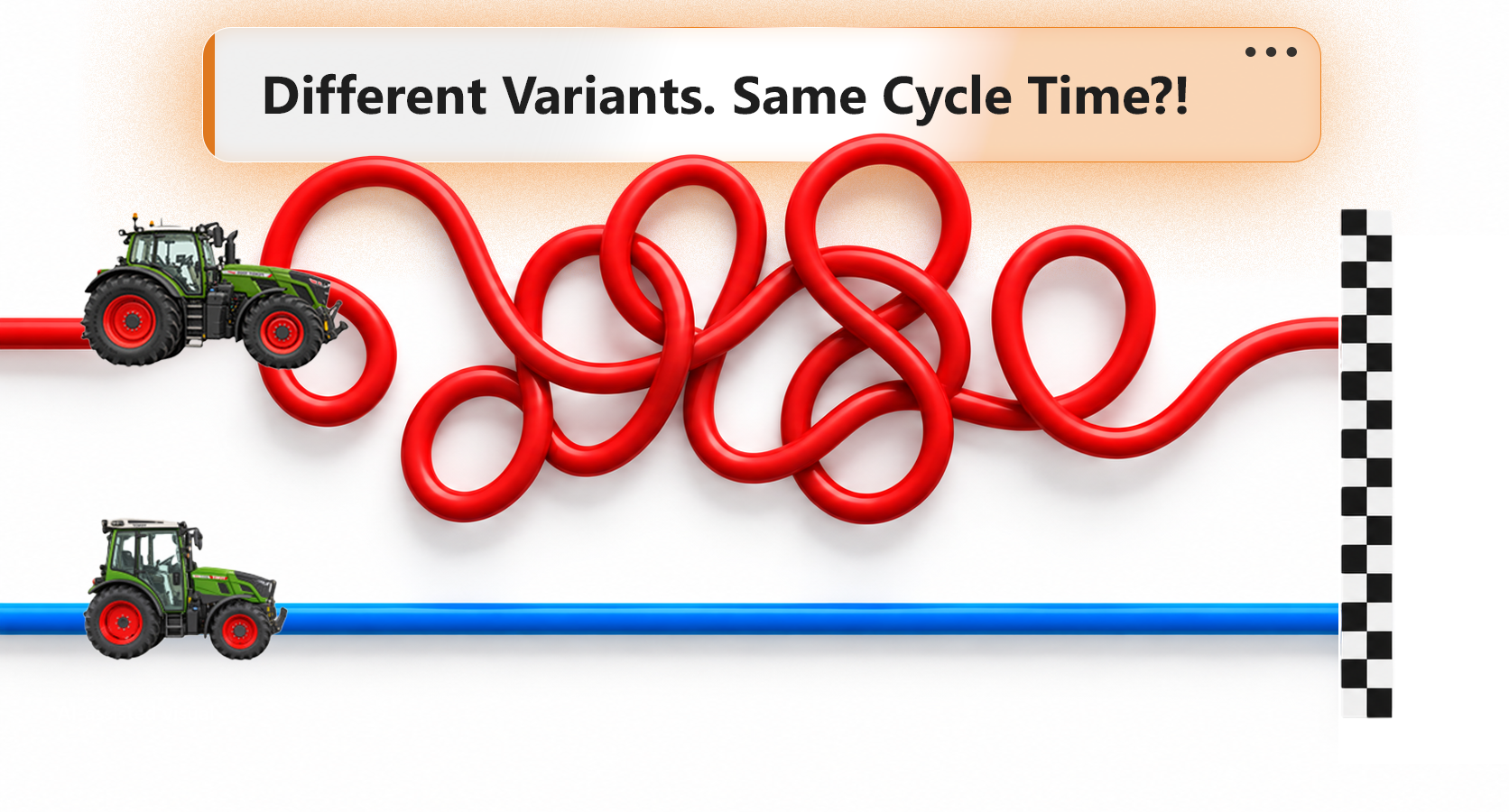
How variable-cycle production compensates for model differences in assembly, where it reaches its limits, and why line balancing remains the same.
Learn More
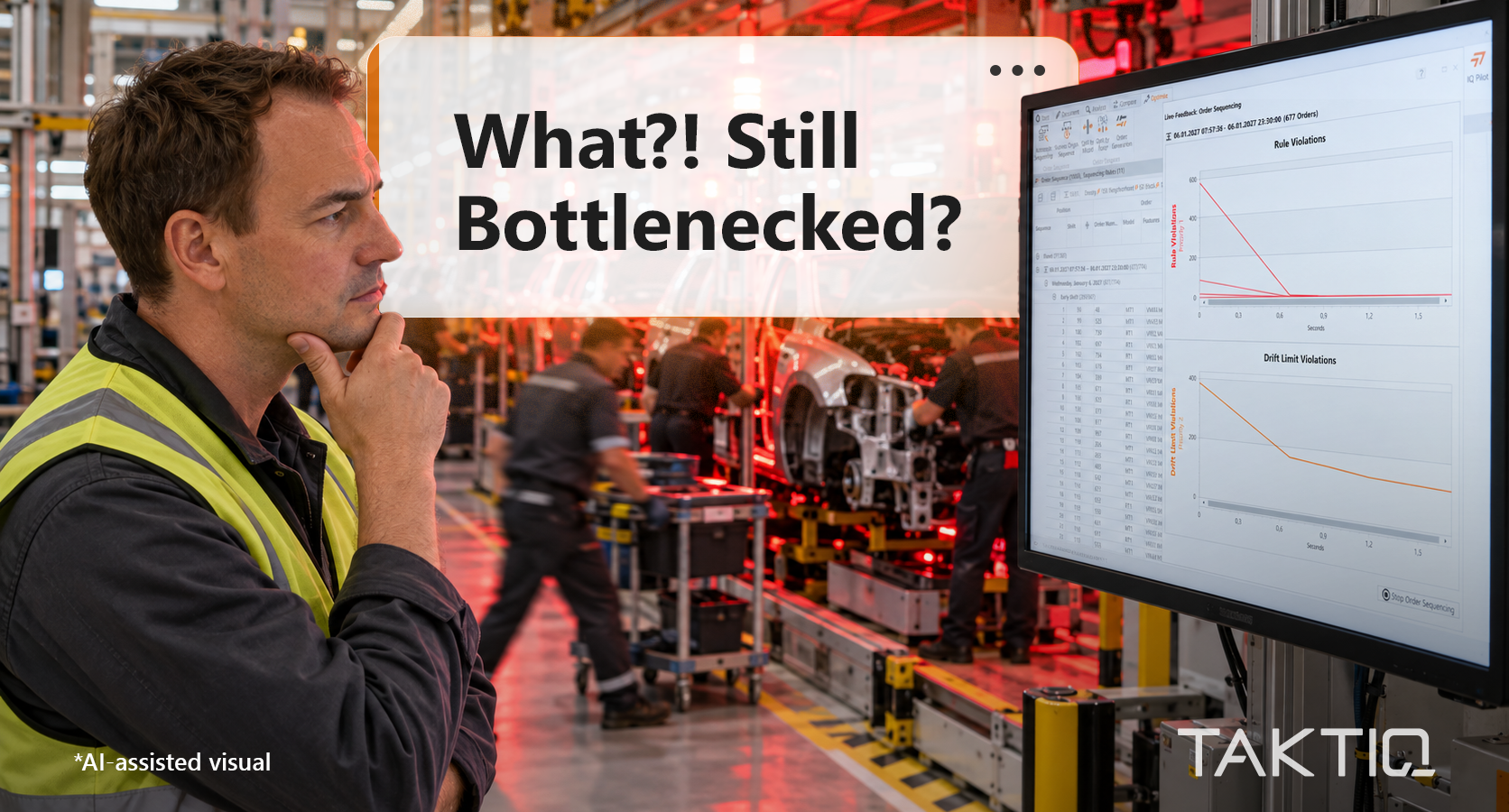
Bottlenecks Despite Line Balancing: Why Individual Workplacees Are Overloaded and How Line Balancing and Sequencing Work Together.
Learn More

Line Balancing in High-Variety Assembly: Why Manual Planning Has Its Limits and What Data-Driven Line Balancing Can Achieve.
Learn More